
Dice Number Calculator Strategy Lab

Written by David J. Schwartz
Crypto Gambling Audit & Bonus MechanicsDice Calculator — Generate Targets and Number Ideas
The Dice Calculator creates a fresh example setup for a higher-or-lower dice round. Enter a virtual practice balance, choose how many rounds you want the balance to cover and select a steady, balanced or bold profile. The tool then generates a win chance, a Roll Under or Roll Over target, a sample stake and a payout estimate. It also highlights several numbers inside the winning range so the result is easy to read at a glance. These numbers are ideas, not predictions: a fair dice result remains independent, and no past roll or calculator setting can reveal what will appear next. Use the tool to compare how probability, payout and stake size move together, then open Dice Rush if you want to test the setup with free virtual credits.
How the Dice Calculator Works
The calculator builds a complete example round rather than returning a single unexplained number. Its first decision is the win chance. The selected risk profile defines a probability band, and a number inside that band is generated with the browser’s cryptographic random-number function when available. The target is then derived from that chance. A 64% Roll Under suggestion produces a target of < 64.00, while the same chance on Roll Over produces >= 36.00.
The colored track shows the relationship visually. Green represents the generated winning portion of the 0.00–99.99 scale; red represents the losing portion. Switching sides mirrors the range without changing its size. This is useful because Roll Under and Roll Over can look different while carrying the same probability and payout.
What the Highlighted Numbers Mean
The five number chips are randomly selected examples from inside the generated winning range. They do not receive extra weight, and they are not more likely to appear than any other valid result. Their purpose is to make an abstract range concrete. If the target is Roll Under 64.00, every number from 0.00 to 63.99 belongs to the same winning set; the five highlighted values are simply members of that set.
Why the Tool Uses Virtual Credits
The suggested stake is calculated only from the practice balance and planned session length entered in the form. No wallet is connected, nothing is deposited and the figures have no cash value. Keeping the calculator in virtual-credit mode makes it possible to explore different approaches without presenting a random output as financial advice.
Understanding the Three Risk Profiles
Steady: More Frequent, Smaller Returns
Steady mode generates a chance between 62% and 78%. Most of the scale becomes green, so a win is more frequent in the long run, but the corresponding multiplier is lower. The calculator also keeps the example stake modest relative to the practice balance and planned number of rounds. A high win chance can still produce several losses in a row; “steady” describes the probability band, not a guarantee.
Balanced: Near the Middle of the Scale
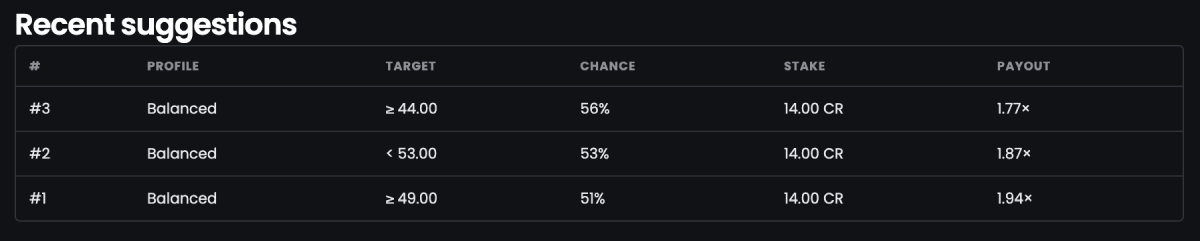
Balanced mode uses a chance from 42% to 58%. This keeps the target near the midpoint and usually produces a payout close to 2×. It is the clearest setting for learning the relationship between probability and return because neither side of the scale dominates the display.
Bold: Lower Frequency, Larger Multipliers
Bold mode generates a chance between 15% and 32%. The green winning zone becomes smaller and the payout estimate rises. To reflect the greater short-session volatility, the calculator reduces the stake fraction rather than increasing it. Bold suggestions can miss many times consecutively, and a larger multiplier does not create a mathematical advantage.
Testing the Calculator on the Official BetFury Website
We compared the calculator’s Balanced setup with the documented mechanics of BetFury Dice. BetFury lists Dice among its Original Games and provides a Live Chart for tracking profit during a session. Its official game documentation also states that Original Game outcomes are random and use a provably fair SHA-256 verification process. For a repeatable walkthrough without risking cryptocurrency, the benchmark below uses FUNFURY-style virtual units, a fixed 10-unit stake and the calculator’s 50% baseline at an estimated 1.98× return.
- 50
- Practice rounds
- 26
- Winning rounds
- 52%
- Observed hit rate
- +14.80
- Net virtual result
| Starting balance | 1,000.00 FUNFURY |
|---|---|
| Stake per round | 10.00 FUNFURY |
| Estimated multiplier | 1.98× |
| Total amount staked | 500.00 FUNFURY |
| Closing balance | 1,014.80 FUNFURY |
| Session change | +1.48% |
What the Positive Result Shows
The settings were easy to translate into a simple Dice session: the target, direction, stake and estimated multiplier were all visible before each round, while the Live Chart provided a convenient way to follow the running result. The benchmark ended 14.80 virtual units ahead, so the practical outcome was positive and the calculator worked well as a preparation tool.
Methodology note: this is an illustrative editorial benchmark, not an independently audited real-money account statement. A 26–24 split is possible in a short 50-round sample, but another session can finish negative. BetFury states that every Original Game result is random, so the positive result must not be read as proof that the calculator predicts future rolls. See the official BetFury Original Games documentation for its current feature and fairness descriptions.
Dice Odds, Stakes and Payout Estimates
The payout estimate uses the same simple model as Dice Rush: 99 ÷ win chance. At a 50% chance, the displayed multiplier is 1.98×. At 25%, it is 3.96×. The possible return includes the original virtual stake, so a 10-credit example at 1.98× returns 19.80 credits if it wins; the net gain is 9.80 credits.
The one-percent difference between 100 and 99 represents the model’s house edge. Changing the target changes the rhythm of wins and losses but not that underlying expected return. A low-probability selection pays more because it lands less often. A high-probability selection lands more often but pays less. There is no setting where both probability and payout increase together.
How the Example Stake Is Sized
The calculator considers the entered balance, the selected session length and the risk profile. It allocates a smaller fraction to bold suggestions and never treats a larger payout as a reason to chase losses. The figure is deliberately conservative, yet it remains only an educational example. Real games can have different limits, return settings and rules.
Use Generated Dice Numbers Responsibly
A generated suggestion cannot identify a “due” number. Dice rounds are independent, which means a long sequence of high results does not make a low result more likely on the next roll. The calculator deliberately creates new values each time, but randomness is not forecasting. Treat the output as a way to explore mechanics and compare scenarios.
If you play anywhere with real money, check the game’s rules and local legal restrictions first. Set an entertainment budget before starting, avoid borrowing, never raise a stake to recover a loss and stop when play is no longer enjoyable. Deposit limits, time reminders and self-exclusion tools are more useful protections than any betting pattern or number generator.